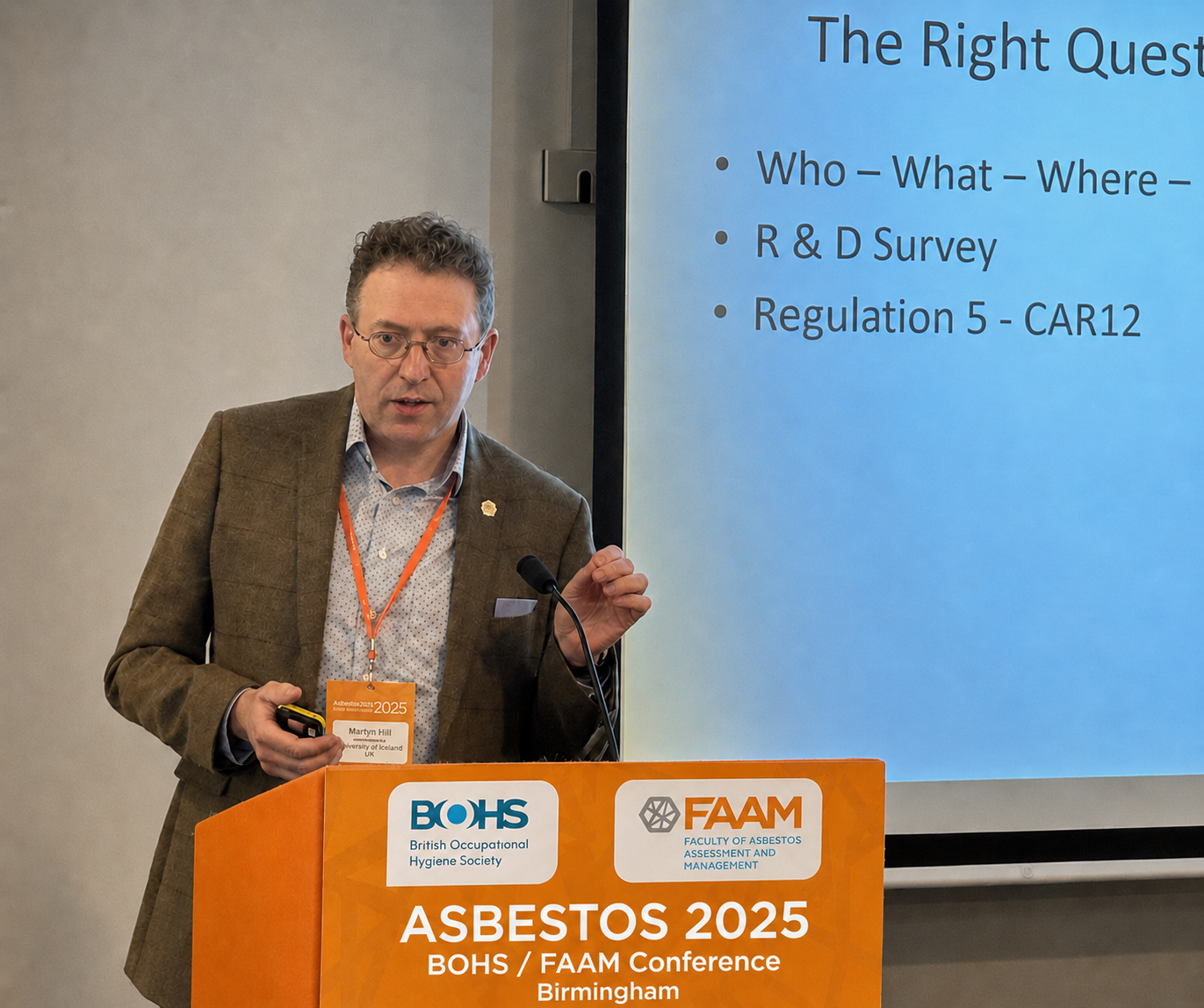
About Marcus Hill: Marcus Hill is Director of Asbestos Risk Control Ltd, an independent asbestos consultancy based in Edinburgh.
Marcus holds the Certificate of Competence in Asbestos and has extensive experience across asbestos surveying, asbestos management, consultancy, project support and dutyholder advice. In 2025, Marcus contributed to the FAAM Asbestos Faculty Conference as a FAAM conference committee member and speaker, taking part in the day two session on asbestos management during construction projects.
The FAAM Asbestos Faculty Conference 2025 brought together specialists from across the asbestos sector to discuss current evidence, regulation, project delivery, data quality, professional competence and the future direction of asbestos management.
The conference covered a wide range of themes, from exposure modelling and long-term worker health data to asbestos definitions, human factors, national asbestos mapping, industry research and the professional recognition of asbestos surveyors. Across the sessions, one recurring message was clear: effective asbestos management depends not only on regulations and procedures, but also on professional judgement, communication, accountability and the quality of information provided to those making decisions.
Marcus Hill’s contribution: asbestos management during construction projects
On day two of the conference, Marcus Hill of Asbestos Risk Control contributed to a session exploring the complex challenges of managing asbestos during construction and refurbishment projects.
The session considered asbestos project management from several viewpoints, including the dutyholder, the consultant and the construction project team. The purpose was to improve understanding between the people who commission asbestos work, those who manage buildings, those who survey and advise, and those who must deliver projects safely on site.
Marcus gave the consultant’s perspective, focusing on the need for asbestos professionals to understand their clients, how they work, what they know, and just as importantly, what they may not know. This is particularly important where clients are unfamiliar with asbestos regulations, construction processes or the limitations of asbestos survey reports.
A central theme of Marcus’s contribution was that asbestos surveyors and consultants should not simply collect data. Their role should include helping clients understand risk, scope the work properly, interpret survey information and make informed decisions before refurbishment, maintenance or demolition work begins.
Key message from the session:
Poor asbestos outcomes are often not caused by one dramatic failure. They usually arise from unclear scopes of work, incomplete information, weak communication, inadequate planning, and assumptions made by people who do not fully understand the asbestos risks within the project.
Survey quality, feedback and competence
Marcus also discussed the difficulty of improving survey quality where there is little meaningful feedback to the surveyor. A surveyor may complete a report, move on to the next job, and never see how the information was used by the client, contractor or project team.
This weak feedback loop can limit professional development. If surveyors are not involved in wider project discussions, and if clients are not equipped to challenge poor or unclear reports, mistakes can become normalised. Over time, this can reduce the quality of asbestos information available to dutyholders and project teams.
Marcus referred to the Dunning-Kruger effect as a useful way to understand how people may overestimate their own expertise when they lack meaningful feedback. In asbestos surveying, this creates a particular concern because decisions are often judgement-based, and poor judgement may not be obvious until something has gone wrong.
The wider conference themes
The wider conference programme showed how broad and interconnected asbestos management has become. The presentations ranged from scientific research and disease data to practical project management, human behaviour, national asbestos data systems and professional standards.
Professor John Cherrie opened the conference by examining how asbestos exposure can be modelled, including the comparative risks of managing asbestos in situ against the risks arising during removal work. His presentation encouraged delegates to consider where policy effort should be directed and how decisions about asbestos in buildings should be based on evidence rather than assumption.
Gillian Nichols of the Health and Safety Executive provided insight from the long-running Great Britain Asbestos Worker Survey. This unique dataset has followed asbestos workers for more than 50 years and continues to provide important information about occupational asbestos exposure, disease risk and the impact of changing working practices.
Dr Andrey Korchevskiy explored the definition of asbestos and the characteristics that make fibres hazardous, including bio-persistence, rigidity and fibre dimensions. His presentation challenged delegates to think beyond simple labels and consider how fibre behaviour relates to health outcomes.
Other sessions considered international asbestos policy, human factors, analytical methods, research priorities and the future of the asbestos removal industry. The conference also included updates from international organisations, including FAMANZ and the Global Asbestos Forum.
Human factors and real-world behaviour
One of the strongest themes from the conference was the importance of human behaviour. Procedures, regulations and forms are only effective if they reflect how people actually work.
The human factors session explored the gap between how work is imagined by managers, how it is described by workers, how it is written in procedures, and how it is actually done in practice. This has direct relevance to asbestos management, where failures often occur because written systems do not match real site conditions or human behaviour.
For asbestos dutyholders and project teams, this reinforces the need to test whether procedures are workable, whether information is reaching the right people, and whether controls are understood by those expected to apply them.
Data, mapping and the future of asbestos management
The conference also explored the growing role of data in asbestos management. Presentations on predictive modelling, national asbestos mapping and asbestos information systems showed how better data could help prioritise risk, support public policy and improve decision-making.
Rick Vandeson from Australia’s Asbestos and Silica Safety and Eradication Agency presented work on the National Residential Asbestos Heat Map, a predictive tool designed to estimate the likelihood of asbestos presence in residential areas. This demonstrated how machine learning and national datasets can support proactive asbestos risk management.
John Richards of the Asbestos Information Certificate discussed the need to improve how asbestos survey data is recorded, structured and used. A key issue is that large amounts of valuable asbestos information are locked inside inconsistent reports, making it difficult to use that data effectively at national, organisational or building level.
Professional recognition and asbestos surveyor accountability
The conference also considered the future professional status of asbestos surveyors. Kevin Bampton, BOHS CEO, discussed the development of a publicly searchable register of asbestos surveyors and the longer-term possibility of a route to chartered status for asbestos professionals.
This theme links closely to Marcus Hill’s wider work and commentary on competence, professional accountability and the need to recognise asbestos surveying as a judgement-based professional activity rather than a simple sampling exercise.
In Marcus’s view, the asbestos industry needs systems that support both organisational quality and individual professional responsibility. The quality of asbestos management depends on competent people making informed decisions, communicating clearly and taking responsibility for the advice they provide.
Why this matters to clients and dutyholders
For clients, dutyholders and project teams, the lessons from the conference are practical. Good asbestos management is not achieved by simply holding a report on file. It requires clear scope, good communication, accurate information, competent interpretation and proper integration into project planning.
Refurbishment and maintenance work can create significant risk if asbestos information is incomplete, misunderstood or not communicated to those doing the work. This is why survey planning, project understanding and consultant involvement are so important.
At Asbestos Risk Control Ltd, this approach is central to how we work. We aim to provide practical asbestos advice that supports real decisions, not just compliance paperwork. Whether the work involves a management survey, refurbishment survey, asbestos management plan or project-specific consultancy, the goal is to help clients understand what the information means and how it should be used.
ARC view:
Asbestos surveys and management plans should be practical tools for decision-making. They should help clients understand risk, plan work safely and prevent accidental disturbance of asbestos-containing materials.
Continuing industry involvement
Marcus Hill’s participation in the FAAM Asbestos Faculty Conference reflects Asbestos Risk Control’s continuing involvement in industry discussion around asbestos management, survey quality, professional competence and the future direction of the sector.
These issues are not abstract. They affect how asbestos work is planned, how buildings are managed, how clients make decisions, and how workers are protected during maintenance, refurbishment and demolition projects.
The conference reinforced a simple but important point: better asbestos outcomes depend on better information, better communication, and better professional judgement.


