I am increasingly concerned by the way asbestos management information is being stripped down, locked away and then presented as efficiency.
I understand the appeal of portals, QR codes, dashboards and tidy registers, who doesn't love a good well organised database. Nobody wants asbestos information buried in old folders or scattered across different reports. A good system should make information easier to find, easier to check and easier to use.
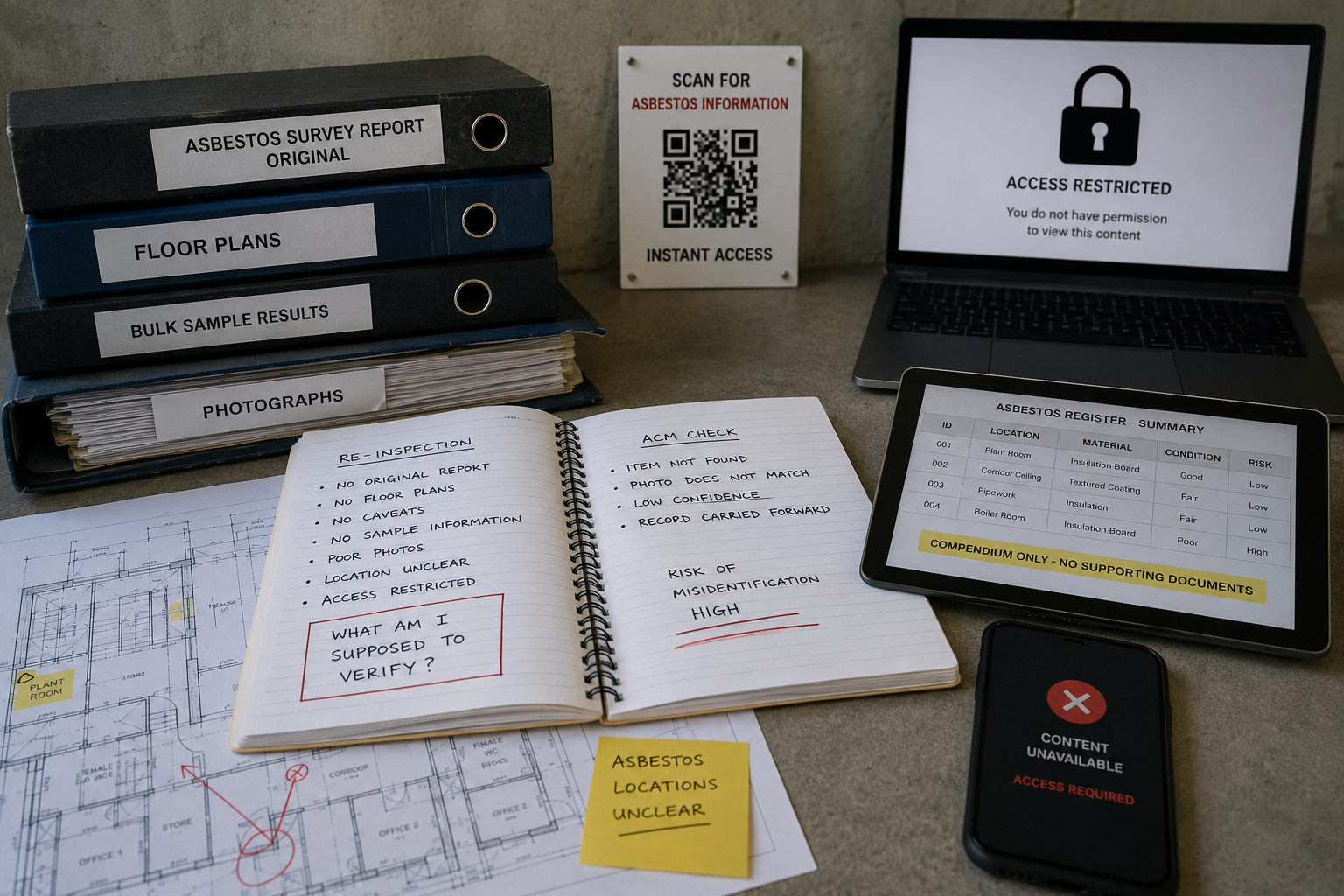
But that is not always what is happening. Too often, the original asbestos survey report is disappearing from view and being replaced by a compendium, a register line or a portal entry. That may look efficient, but it can remove the very information needed to understand the survey. The caveats, exclusions, limitations, access issues, sample results, photographs, plans and narrative are not padding. They explain what was inspected, what was not inspected, and how much confidence can be placed in the findings. A lone register or compendium without plans or supporting survey information may look tidy, but in practical terms it can be dangerously thin.
A compendium may look neat, but it is not a proper survey report. In my view, compendium reports create a serious problem when they become the main record rather than a summary. They encourage people to rely on a stripped-down version of the information, while the evidence and context behind it are either missing, inaccessible or forgotten.
This becomes a real issue during re-inspections. A re-inspection is not just a routine condition check. The person doing it needs to understand what they are looking for. If they know the building, they may already understand its layout, history and oddities. Often they do not. They arrive cold and have to rely entirely on the information provided to them.
That is fine if the information is good. It is not fine if there is no original survey report, no marked-up plan, no paper record on site, no visible caveats, no accessible sample information, and photographs that are wrong, missing or bear little resemblance to the item described. In those circumstances, the reinspection can become vague through no single obvious fault on the day. The inspector is working from poor information, the record is updated from that weak starting point, and the quality of the data can become further diluted with each cycle.
If an ACM cannot be confidently found, if the photograph does not match, if the original limitations cannot be checked, or if the supporting evidence is unavailable, the re-inspection should say so clearly. Otherwise, the process risks carrying forward the same weakness year after year and giving the impression that something has been checked when the record itself may be unreliable.
The QR code issue sums this up well. A QR code on site looks modern and efficient. But if it leads to a restricted portal, a login screen, a dead link, or information that relevant people cannot access, then it is not providing information.
Since when was an asbestos register top secret? I understand that systems need access controls. Not everyone should be able to alter records or access every client document. But there is a clear difference between sensible control and blocking access to basic asbestos management information from people who genuinely need it.
A paperless system is only an improvement if the digital route works. If there are no paper records on site and the portal or QR code does not provide usable access, the building may effectively have no usable asbestos information available to the people who need it. That is not efficiency. It is a serious loss of practical control dressed up as efficiency.
My frustration is that parts of the industry appear to be gold-plating the presentation while the underlying information quality is poor. The portal looks professional. The QR code looks modern. The compendium looks tidy. The re-inspection record looks complete. The accreditation badge looks reassuring.
But if the original report is missing, the plans are missing, the caveats are missing, access is blocked, photographs are unreliable and asbestos continues to be missed despite re-inspections, then the issue is not presentation. It is a breakdown in asbestos information management.
Asbestos management depends on proper information, competent judgement and access to the records that explain the building. It is not enough for information to exist somewhere in a system. It has to be usable by and accessible to the people who need it, and complete enough to support the decisions being made.
Efficiency should make asbestos information clearer, not thinner. Digital systems should improve access, not block it. Re-inspections should test the reliability of the record, not blindly repeat it.
Some of the largest organisations in the sector should be leading on information quality, not normalising thinner records, restricted access and over-simplified outputs. Whether intentional or not, the result is the same: less context, weaker traceability and poorer information being passed forward as though it represents improvement.
ARC has a client portal in use with a small number of selected clients, but the portal itself is not the selling point. The more important question is whether any system, including ours, is fit for purpose. Does it preserve the survey context? Does it keep plans, caveats, photographs and sample information accessible? Can the right people actually use it in the building? That is the standard I think these systems should be judged against.
